AG Todd Blanche accused of obstructing ballot curing with Mississippi meeting
 Prefer us on Google
to see more of our voting rights news coverage when you search.
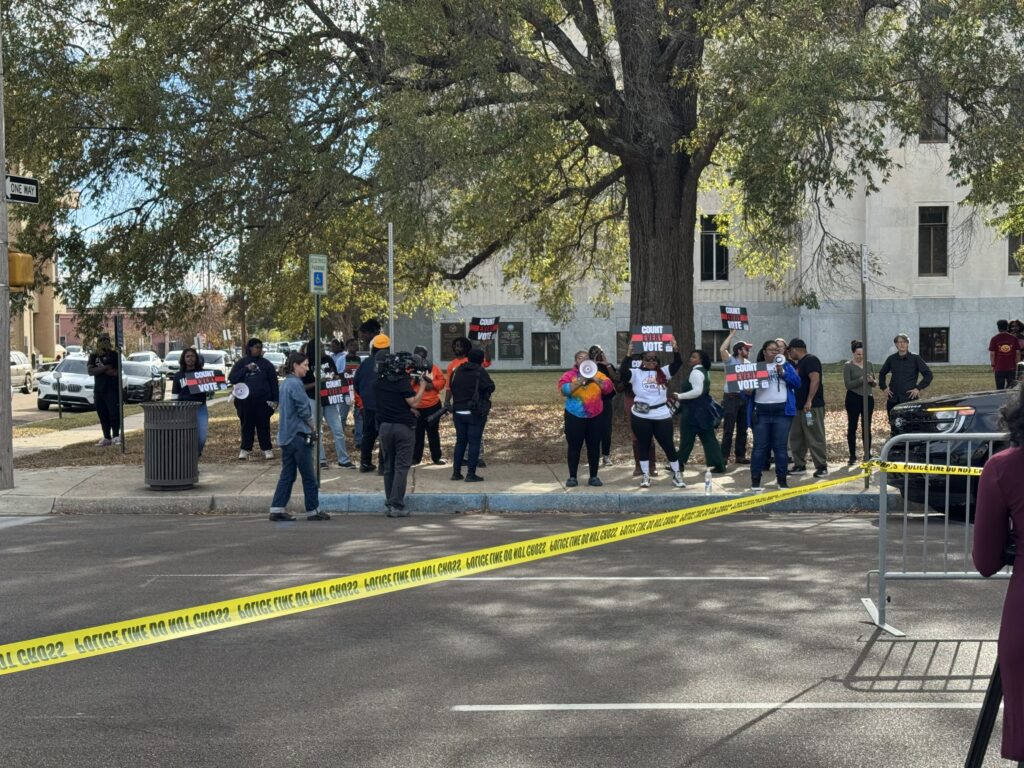
Pro-voting demonstrators protested U.S. Attorney General Todd Blanche’s appearance Monday near where crucial voting processes are playing out in Mississippi’s closely watched midterm election.
Blanche, accompanied by a large police escort, attended a meeting at Jackson City Hall across the street from the Hinds County Courthouse, where certain voters must go to cure affidavit ballots they cast in last week’s midterm elections.
The meeting — and the roadblocks and police presence it brought — could intimidate or inconvenience voters, demonstrators said.
“Don’t interrupt our vote,” they chanted.
Get updates straight to your inbox — for free
Join 350,000 readers who rely on our daily and weekly newsletters for the latest in voting, elections and democracy.
“This press conference could have been done Friday, could have been done Wednesday, and it could have been done somewhere else versus City Hall in Jackson in Hinds County, one of the Blackest counties ever,” demonstrator Valencia Robinson told Democracy Docket.
Mississippi is still counting ballots in a pivotal U.S. Senate race. As of Monday, Democrat Scott Colom leads incumbent Sen. Cindy Hyde-Smith (R) by around 2,500 votes. If elected, Colom would become Mississippi’s first Black U.S. senator since the Reconstruction Era.
Voters who did not have photo ID when they went to vote on Election Day had to cast so-called affidavit ballots. They now must go to the local Circuit Clerk’s office by 5 p.m. on Tuesday, Nov. 10, to present an acceptable photo ID or sign a religious objection affidavit in order for their votes to be counted.
Angela Grayson, the director of civic engagement and voting rights for the Mississippi Black Women’s Roundtable, said her organization came out to ensure voters knew they still had time to cure their affidavit ballots.
She said Blanche’s meeting was inconvenient for voters.
“Folks don’t understand what’s going on and are being rerouted because of the road closures,” Grayson told Democracy Docket. “We know that a police presence is just intimidation. People don’t know what’s going on. There’s fear because there’s snipers on top of all of these buildings around.”
Not everyone accepted that premise.
Ty Martin, a former political director of the Mississippi Republican Party, was having lunch in the area when he saw police with rifles on the roof of City Hall.
“I would question where the protest is being held because, in fact, no ballots are being counted in this building behind us,” Martin said, referring to the courthouse.
Martin acknowledged that ballot curing is still part of the electoral process. But he said the protesters should be more concerned about the Hinds County Election Commission Office, where officials count affidavit ballots.
But with affidavit ballots appearing likely to determine the winner of the Senate race, the demonstrators were convinced that Blanche’s visit could dissuade voters from curing their ballots.
“Voting is a right and not a privilege, and you know it’s taken so long to try and convince people that it is a right,” Robinson said. “We have so many people thinking that their vote doesn’t count, and this right here is proving every vote counts.”