New Hampshire argues voters have no right to cast mail ballots
 Prefer us on Google
to see more of our voting rights news coverage when you search.
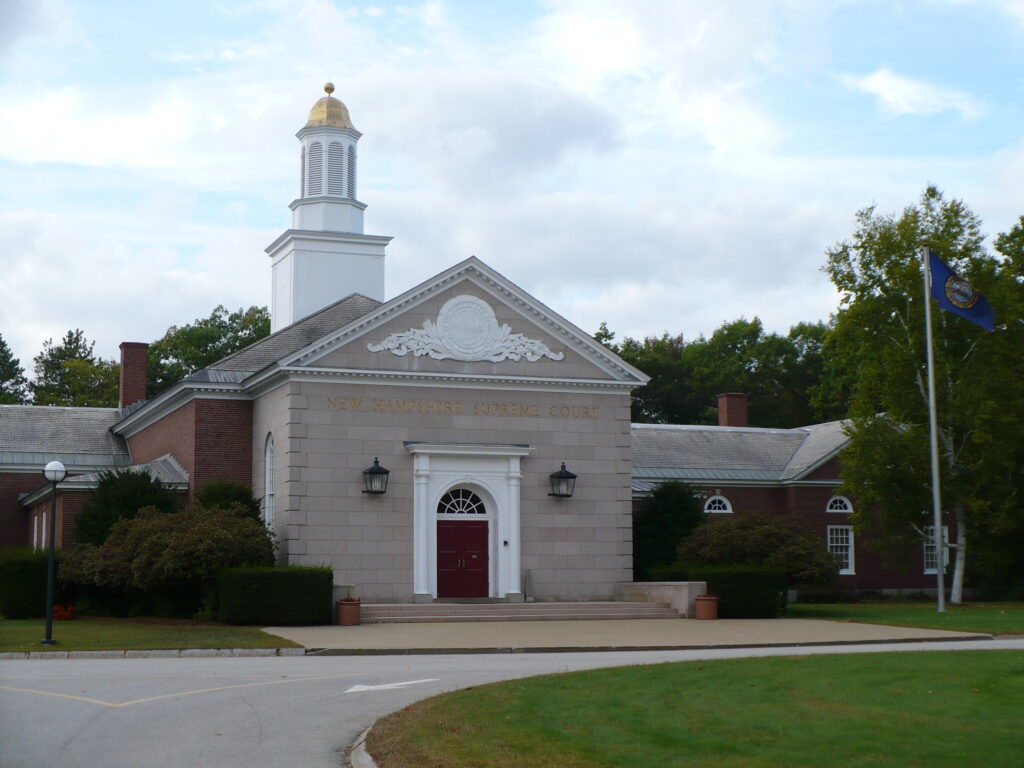
In a hearing before the state Supreme Court, an attorney representing New Hampshire’s Secretary of State and Attorney General’s offices argued that voters — particularly voters with disabilities — do not have a constitutional right to burden-free mail voting.
Mary Triick, a senior assistant attorney general in the New Hampshire Department of Justice, made the argument Monday, even as the state’s constitution requires that absentee voting be available to voters who cannot vote in person.
“Obviously, you have a fundamental right to vote. You do not have a fundamental right to vote absentee,” Triick said.
Monday’s hearing covered a lawsuit brought by three visually impaired voters* against New Hampshire Secretary of State David Scanlan (R) and New Hampshire Attorney General John Formella (R), challenging a new state law, SB 287, that imposes strict identity-verification requirements on mail voting.
Get updates straight to your inbox — for free
Join 350,000 readers who rely on our daily and weekly newsletters for the latest in voting, elections and democracy.
SB 287, which went into effect last year, mandates that voters either present a valid photo ID in person when requesting an absentee ballot or submit a notarized signature or a copy of their ID with their absentee ballot application for every local, primary and general election.
The voters alleged that the new requirements to receive an absentee ballot imposed undue burdens on disabled, elderly and low-income voters’ right to vote, which the New Hampshire Constitution guarantees. However, a trial court dismissed their suit last December, claiming that the ID requirements were “ordinary burdens” and that the state’s motivations for imposing them — ensuring election security and preventing fraud — justified the burdens.
Plaintiffs then appealed to the state Supreme Court, though the state’s five Supreme Court justices did not oversee Monday’s hearing. All the justices recused themselves from the case, and the court appointed Superior Court justices to hear it instead.
Much of the state’s defense in the hearing rested on McDonald v. Board of Election Commissioners of Chicago, a 1969 U.S. Supreme Court ruling. The Court held that because absentee voting is a privilege rather than a constitutional right, states have broad discretion to decide who gets access to it and don’t need to justify restrictions with much more than a rational basis.
Justice Charles Temple noted one key difference between McDonald and the case before the state Supreme Court: Unlike the U.S. Constitution, the New Hampshire Constitution orders the legislature to make absentee voting available to certain voters, including those with physical disabilities.
“Isn’t that a huge difference?” Temple asked.
Triick argued that it would be an appreciable difference if plaintiffs asked the court to recognize a constitutional right to vote by absentee ballot. But the state constitution ordering the legislature to make absentee voting available to certain voters does not establish a right to vote absentee, she added.
“It’s certainly not clear that that establishes a fundamental right to vote absentee, right? Not every topic addressed in the Constitution is a fundamental right,” Triick said.
In her argument, Triick appeared to separate the right to vote from the right to vote absentee. But some justices seemed to take issue with that line of argument.
“Isn’t that rooted in your fundamental right to vote?” Temple asked, to which Justice Martin Honigberg added that absentee voting may “make sure that people can exercise that fundamental right?”
“I think that voting absentee is part of exercising your fundamental right to vote, but you have to be alleging that the thing unconstitutionally burdened is your right to participate in the franchise writ large and not simply your ability to get an absentee ballot,” Triick said.
During rebuttal, David Fox, an attorney representing the visually impaired voters, said the state’s focus on whether a right to vote absentee exists ignores the lawsuit’s central claim: that SB 287 will affect certain voters’ ability to vote.
“The state seems to fault us, at times, for not alleging a burden on the right to vote, and at other times for not alleging a burden on a right to vote absentee. And it is sort of a divide-and-conquer strategy that ignores what I think is the quite straightforward nature of the claims being made,” Fox said.
Even before SB 287, New Hampshire had some of the strictest mail-voting laws in the country. It’s one of the few states that still require voters to have a qualifying reason to vote absentee, such as being out of town on Election Day, having a disability or illness that prevents in-person voting or having a religious observance conflict.
Moreover, the state lacks a grace period for ballots that do not arrive by the end of Election Day. That means some voters can be disenfranchised through no fault of their own, such as mail delays. A separate law — SB 218 — adopted at the same time as SB 287 also requires that voters registering to vote by absentee ballot provide documentation demonstrating citizenship.
SB 287 was just one of a host of new voting restrictions New Hampshire Republicans have pursued in recent years. In addition to adopting a strict voter ID law, the state also eliminated student identification cards as an acceptable form of voter ID. The U.S. Supreme Court lifted a lower court’s order allowing limited use of student IDs just weeks before the 2026 midterms.
The state also required all voters to provide documentary proof of citizenship to register, though a federal court determined this year the demand was an “unjustifiable burden on the right to vote in violation of the First and Fourteenth Amendments.” New Hampshire’s appeal of the federal court order is ongoing in the First Circuit.
*The Elias Law Group (ELG) represents the plaintiffs in this case. ELG Firm Chair Marc Elias is the founder of Democracy Docket.