Republicans challenge thousands of Ohio ballots, voting groups say
 Prefer us on Google
to see more of our voting rights news coverage when you search.
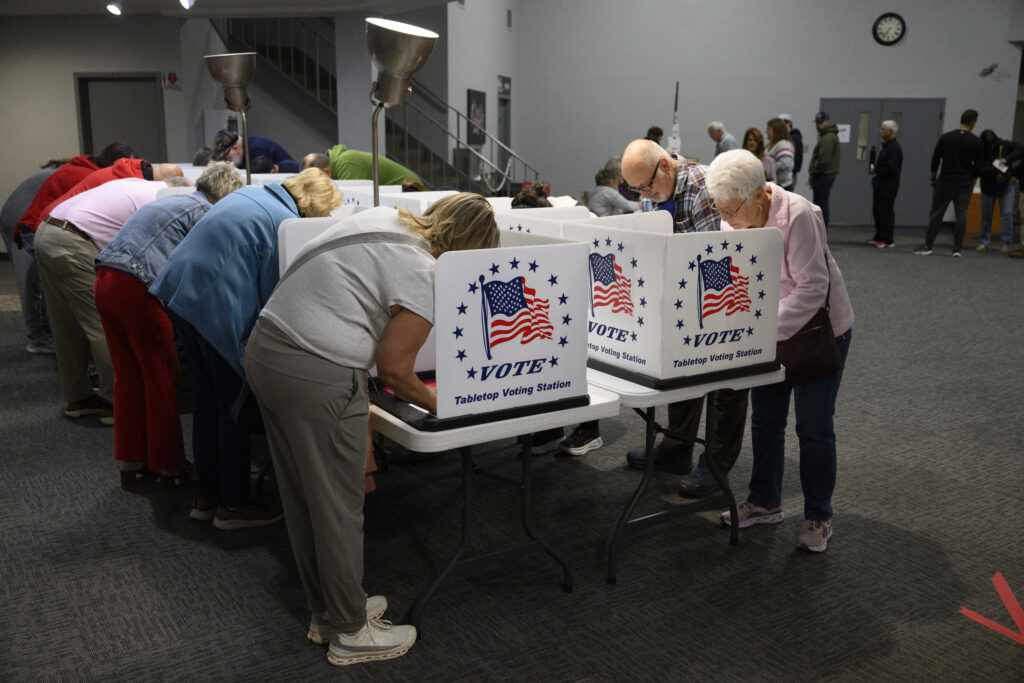
A law firm representing Republican candidates in Ohio has asked counties not to count thousands of ballots from people who recently moved within the state, the Ohio branches of the League of Women Voters (LWV) and the ACLU said.
The pro-voting groups said the Cincinnati-based Taft Law Firm sent county election boards letters this week — almost two weeks after Election Day — demanding that they invalidate provisional ballots cast by voters who did not update their registrations after moving counties in the state.
The Taft letters represent the latest GOP attempt to block election officials from counting provisional ballots in close midterm races. They echo similar demands Republicans made in Mississippi earlier this month during a closely watched U.S. Senate race.
In their own round of letters, the Ohio LWV and ACLU asked all 88 county election boards in the state to disregard Taft’s requests. The firm’s demands would “violate the First and Fourteenth Amendment rights of the voters in question” if fulfilled, the groups warned.
Get updates straight to your inbox — for free
Join 350,000 readers who rely on our daily and weekly newsletters for the latest in voting, elections and democracy.
The Taft letters claimed that, under Ohio election law, such voters should not have been allowed to cast a provisional ballot at polling locations. Instead, they should have cast their provisional ballots at a board of elections office, the firm asserted.
“The Board should reject that category of ballots because Ohio law makes the location of casting an express condition of a county-to-county mover’s eligibility to vote in the election,” the Taft Law Firm said in a four-page Nov. 15 letter to Lucas County, which contains Ohio’s fourth-most-populous city, Toledo.
The firm sent the Lucas County letter, which Democracy Docket obtained, on behalf of Edward Schimmel, a Republican candidate for Ohio House District 44. The race remains too close to call, as Schimmel leads his Democratic opponent, David Fournier, by only 33 votes as of noon Wednesday.
The firm warned that its “clients reserve all rights, claims, and objections, including the right to seek relief in court” if Lucas County does not comply with its demands. The county appears not to have done so.
In a session Monday, Lucas County election board officials explicitly said provisional ballots cast by voters who moved from another Ohio county can be counted after they are verified, according to WTOL, a CBS-affiliated television station in Toledo. Officials also approved 1,540 provisional ballots cast on Election Day and 835 provisionals cast before, and rejected another 350 provisionals.
The Taft Law Firm did not respond to Democracy Docket’s request for a response to LWV and ACLU’s letters to county officials.
It’s unclear exactly how many counties Taft sent letters to and what other candidates the firm represents. It’s also unclear how many ballots Taft challenged through its demands, but LWV and ACLU said “thousands.”
Alongside disagreeing with the firm’s interpretation of Ohio election law, LWV and ACLU argued that the voters Taft challenged could not be disenfranchised because of potential mistakes by election officials.
The voting organizations noted that guidance Ohio Secretary of State Frank LaRose (R) sent election officials for this year’s midterms clearly indicated that voters who moved within the state could cast provisional ballots at polling locations.
The guidance says that “voters who have moved outside of their county (but still in Ohio) and didn’t update their address by the deadline” can still cast provisional ballots at polling locations.
In its letters, Taft claimed that guidance was incorrect.
However, disenfranchising voters because of that mistake “would amount to disenfranchising thousands of registered Ohio voters en masse for acting in accordance with the express instructions of the Ohio Secretary of State, as relayed through poll workers,” the LWV and ACLU argued.
Taft’s ballot challenges came as Democrats broke the Republican supermajority in the Ohio House by flipping at least eight seats in the chamber. Alongside Schimmel and Fournier’s contests, three other state House races remain too close to call.