After 20 straight losses, Trump DOJ struggles to defend demand for Washington state voter rolls
After losing 20 consecutive lawsuits seeking states’ unredacted voter rolls, President Donald Trump’s Department of Justice conceded Tuesday that its case against Washington is materially no different from the others — but still urged another federal court to embrace the same sweeping legal theory rejected by every court to consider it.
During a lengthy hearing, the judge repeatedly pressed DOJ attorneys to explain why the department needs driver’s license and Social Security numbers of Washington voters to evaluate the state’s compliance with federal election law.
The department insisted those sensitive identifiers are essential, even as it argued that it does not need to identify any factual reason to suspect Washington has violated the law.
Following the hearing, Washington Secretary of State Steve Hobbs (D) cast DOJ’s lawsuit as part of a broader federal effort to force states to surrender protected voter information, arguing that Washington had already provided all publicly available voter data while complying with state and federal privacy laws.
“Rather than addressing any real problem, these lawsuits seek private voter information that is protected under state law,” Hobbs said. “The DOJ’s demands for complete voter rolls are another example of federal overreach and an attempt to exert control over our elections. My office will continue defending Washington voters’ private information while ensuring the integrity of our voter roll remains secure, accurate, and trustworthy.”
Get updates straight to your inbox — for free
Join 350,000 readers who rely on our daily and weekly newsletters for the latest in voting, elections and democracy.
Trump DOJ concedes Washington case mirrors every one it has lost
Early in the hearing, U.S. District Judge Kymberly Evanson noted that courts across the country have uniformly rejected DOJ’s attempt to use Title III of the Civil Rights Act of 1960 to obtain states’ live voter-registration databases.
“By my count, this is the 20th court to address this exact issue,” Evanson said. “Is there any meaningful basis on which to distinguish this case from the many other district courts and the Sixth Circuit Court of Appeals across the country that have dismissed the government’s complaints or denied their motion to compel?”
“No, your Honor,” DOJ attorney Raymond Yang responded. “Relevant facts are similar to all the other cases.”
Yang instead argued that judges around the country had “misconstrued the text, context, structure, history, and original understanding of Title III.”
The concession left DOJ asking the Washington court to reject a judicial consensus that now includes 20 district court rulings and one federal appellate decision — without identifying any distinct facts that might produce a different result.
DOJ proposed an extraordinarily broad reading of the Civil Rights Act’s record preservation provisions. When the judge asked whether Washington could be required to retain voter registration applications dating back 100 years, so long as the voters remained eligible in the most recent federal election, DOJ answered yes.
The department argued that the law’s 22-month preservation period does not necessarily limit how far back its demands can reach.
Trump DOJ says it still needs sensitive voter data….
Washington offered DOJ its publicly available voter list. But the department is demanding the unredacted version containing voters’ full birthdates, driver’s license and Social Security numbers.
The judge asked how obtaining those identifiers would advance DOJ’s stated goal of evaluating whether Washington maintains its voter rolls reasonably.
“That’s because HAVA requires it,” a DOJ attorney initially responded, referring to the Help America Vote Act.
The judge pushed back.
HAVA may require Washington state to maintain identifying information, she noted, but that does not explain why the federal government must possess it.
DOJ then offered a narrower rationale: The information could allow the department to determine whether Washington properly assigns unique identification numbers to voters who do not provide a driver’s license or Social Security number.
But that explanation went beyond the broad purpose DOJ gave in its demand — assessing Washington’s general compliance with federal voter list maintenance laws. It also did not explain why the department needs the sensitive records of every voter rather than targeted information addressing a particular suspected problem.
The argument also conflicts with DOJ’s treatment of other states.
Democracy Docket recently reported that the department labeled Kansas and Montana cooperative after they provided only public voter information, while suing Washington and other states for withholding the same categories of private identifiers.
….but that it doesn’t need to give a factual basis
The judge then focused on Title III’s requirement that a DOJ demand state its “basis and purpose.”
She asked whether the department believes it must identify any factual basis for seeking Washington’s unredacted file.
“No, Your Honor,” Yang replied.
DOJ argued that merely citing its legal authority and generally saying it wants to assess federal compliance is enough. Under the department’s theory, the state cannot defend itself by arguing that DOJ’s factual premise is wrong — and courts may not examine the factual support behind the demand.
In practical terms, DOJ claimed authority to demand the private information of every registered voter in a state without identifying any evidence that the state had done something unlawful.
“We believe that even a legal basis is enough,” Yang said.
Trump DOJ conveniently leaves out its previous plan to use SAVE
Tuesday’s hearing also exposed a significant omission in DOJ’s account of how it planned to use state voter data.
Addressing concerns about the Department of Homeland Security’s SAVE database, DOJ told the court that the department was not planning to use it.
“We’re not using it,” Yang said. “We have no, at this time, no intention of using it.”
That statement may describe DOJ’s present limitations, but it omitted why SAVE is no longer available for the nationwide voter data project.
In a March 12 letter, DOJ documented a plan under which DHS would access voter files collected from states, “enrich” them with information from federal databases and return the results to DOJ. The department would then query the data through SAVE to investigate voters’ citizenship status.
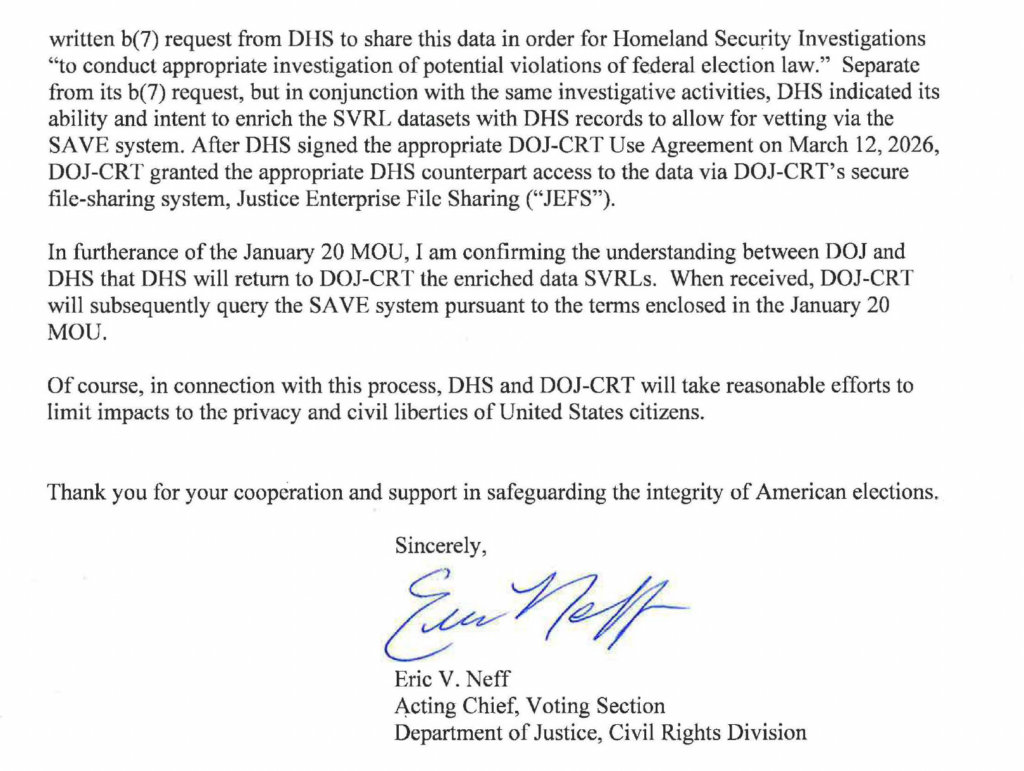
A federal judge in Washington, D.C., subsequently blocked the Trump administration’s expanded use of SAVE for voter verification. DOJ therefore is not presently able to carry out the project it had previously envisioned.
DOJ did not tell the Washington court that it had abandoned — or at least paused — a documented plan after an adverse ruling. Instead, its lawyer invoked the current lack of SAVE use as a reason the court should discount the defendants’ privacy concerns.
“If anything, that helps us because we’re not using it,” the DOJ attorney argued.
But the court is evaluating whether DOJ’s demand had a legitimate purpose when it sought Washington’s voter file, not merely what the department is legally permitted to do with the information today.
The March letter provides evidence that federal immigration data matching was part of DOJ’s broader voter roll project, even though it was not disclosed in Tuesday’s description of the department’s plans.
Pro-voting defendants call DOJ’s voter roll crusade pretextual
Attorneys for Washington and voting rights groups* argued that DOJ’s refusal to identify a state-specific factual basis — combined with its nearly identical demands across the country — shows that its stated list-maintenance investigation is a pretext for amassing a national voter database.
The department sent substantially similar letters to 48 states then filed more than 30 lawsuits when states refused to surrender sensitive voter information.
DOJ did not follow up with questions normally associated with an investigation into voter list maintenance, defendants argued.
“Instead of asking those basic questions, the Department of Justice filed lawsuit in state after state after state after state, amounting to over 30 in total. That demonstrates that the purpose that the Department of Justice has in asking for Washington’s unredacted voter list is not an investigation into whether or not Washington is complying with the National Voter Registration Act,” attorney Renata O’Donnell said. “That looks like an effort to amass as much voter data as possible, and that is not a permissible purpose to ask for the unredacted voter rolls under Title III of the Civil Rights Act.”
DOJ did not identify evidence that Washington had violated federal law and conceded during the hearing that the case was factually similar to every other voter-roll lawsuit it has lost.
The pro-voting defendant said the government’s position would effectively prevent meaningful judicial review: DOJ could issue a demand, wait for a state to refuse and then claim an automatic entitlement to millions of voters’ private information.
“Functionally, your Honor, that would sidestep this court’s review,” O’Donnell said.
The judge did not rule from the bench and said she would issue a written decision as soon as practicable.
A ruling against DOJ would extend a losing streak that now spans 20 district courts and one federal appeals court. No court has ordered a state to surrender its unredacted statewide voter database.
*The Elias Law Group (ELG) represents some of the defendant-intervenors in this case. ELG firm chair Marc Elias is the founder of Democracy Docket.
Maya Bodinson contributed to this reporting.